Choosing the wrong stainless steel for wire rope[^1] can lead to rust, project failure and costly rework. For engineers and purchasing managers, understanding the difference between 304 and 316 is critical to specifying the right grade in drawings and RFQs.
As a simple rule of thumb: use 304 stainless steel[^2] for indoor or dry, non‑corrosive environments where aesthetics and general corrosion resistance[^3] are enough. For any outdoor, coastal or chemically corrosive setting, 316 stainless steel[^4] is the essential choice because of its superior resistance to chloride attack – which is why it is commonly referred to as “marine grade[^5]”.

You now have the basic rule of thumb, but as an engineer or project manager, you know the "why" is just as important as the "what". Relying on rules without understanding them can lead to mistakes when a project has unique demands. Let's delve deeper into the material science so you can select your wire rope[^1] with the confidence of an expert.
What Really Makes 316 Stainless Steel So Much More Corrosion Resistant?
You have probably heard that 316 is “for marine use”, but why exactly? Relying only on a label is risky when a project’s safety and service life[^6] are at stake.
The key difference is the addition of around 2% molybdenum[^7] to the 316 alloy. This alloying element greatly improves resistance to chloride‑induced pitting and crevice corrosion, which are driven by chlorides in saltwater, de‑icing salts and many industrial chemicals. This is the fundamental reason why 316 outperforms 304 in harsh environments.

In my 17 years in this industry, I have seen projects fail simply because the wrong grade was chosen to save a small amount of money upfront. The secret to 316's strength lies in its chemical makeup.
The Power of Molybdenum (Mo)
All stainless steels, including 304, have a thin, invisible layer of chromium oxide on the surface. This "passive layer" is what protects the steel from general rust. However, chlorides—like the salt in seawater—are extremely aggressive and can break down this layer, causing tiny, deep pits to form. This is called pitting corrosion[^8], and it can weaken a wire rope[^1] from the inside out. Molybdenum significantly enhances the stability of this passive layer. When chlorides attack, Molybdenum helps the layer repair itself much faster, preventing these dangerous pits from forming and taking hold.
A Practical Comparison
In practical terms, you can think of it this way: 304 stainless steel[^2] has a good general defence, but 316 has a stronger, more stable passive layer that recovers faster when chlorides attack it.
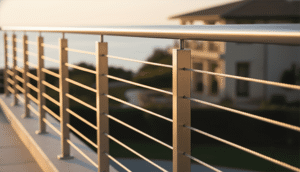
On a seaside balustrade project I consulted on, the client initially specified 304 to reduce material cost. After we explained how quickly tea staining and pitting could appear in that environment, and showed test data comparing the two grades, they switched the specification to 316. The slightly higher initial cost became a calculated investment in safety, appearance and service life.
| Feature | Grade 304 Stainless Steel | Grade 316 Stainless Steel |
|---|---|---|
| Key Alloy Addition | Chromium, Nickel | Chromium, Nickel, Molybdenum (~2%) |
| Corrosion Resistance | Good for general atmospheric | Excellent, especially against chlorides |
| Best Use Cases | Indoor, non-salty outdoor, architectural | Marine, coastal, industrial, food processing |
| Common Name | 18-8 Stainless Steel | Marine Grade Stainless Steel |
| Cost | Lower | Higher (approx. 20-30%) |
Is the Extra Cost of 316 Wire Rope Always Worth It?
Budget pressures are real. You see two similar-looking wire rope[^1]s, but one costs more. It's tempting to choose the cheaper option, but will this decision cost you more later?
No, the extra cost of 316 is not always necessary. If your project is indoors, in a dry climate or shielded from corrosive elements, 304 stainless steel[^2] is a reliable and cost‑effective choice that will perform very well over its expected life. In these conditions, paying more for 316 generally does not bring extra technical benefit.
The key is to match the expected service life and environment of the project with the appropriate grade, instead of simply choosing the most expensive option “for safety”.

The key is to match the material to the environment. Choosing correctly is not about spending the most money; it's about making the smartest investment. For years, I've advised clients on this exact point, helping them allocate their budget where it truly matters—on performance and safety for the specific application.
Calculating the True Cost
When you compare prices on paper, you only see the initial purchase cost. In reality, the total cost of ownership also includes maintenance, inspection, replacement and the impact of any failure or downtime.
For example, a 304 wire rope[^1] on a coastal dock might look acceptable during the first year but start to develop tea staining and pitting after repeated exposure. In three to five years, it may need full replacement. At that point, you are paying for new material, labour to remove and reinstall the rope, and any disruption to operations – often far more than the small initial saving from choosing 304 over 316.
When 304 is the Smart Financial Choice
Let's consider an indoor architectural project, like a suspension system for lighting or decorative panels inside a climate-controlled building. In this scenario, the wire rope[^1] is not exposed to moisture, salt, or chemicals. Using 316 here would be over-engineering. The excellent corrosion resistance[^3] of 304 is more than sufficient, and the money you save can be used in other parts of the project. I worked with a firm designing a large atrium, and we used 304 for all the rigging. The project was completed five years ago, and the components still look perfect. It's about using the right tool for the job.
The decision tree is simple:
- Will it touch saltwater or be near the coast? -> Use 316.
- Will it be exposed to de-icing salts[^9] or industrial chemicals? -> Use 316.
- Is it for a critical application where failure is not an option? -> Use 316 for peace of mind.
- Is it indoors or in a dry, non-salty environment? -> Use 304 and save money.
How Can I Tell the Difference Between 304 and 316 Grade Rope?
You've received a shipment, but the markings are unclear. How can you be sure you got the marine-grade 316 you paid for, not the cheaper 304 that could fail?
Visually, 304 and 316 stainless steel[^4] are identical. The only reliable way for a user in the field to tell them apart is to use a Molybdenum Test Kit. This simple chemical test will produce a distinct color change if Molybdenum is present, confirming it's 316.

Trust is important, but verification is essential in our line of work. I remember visiting a client who was having issues with rusting on "316" hardware he bought from another supplier for his boat. We performed a spot test right there on the dock. The test solution didn’t change color, revealing the material was actually 304. This quick test saved him from installing more faulty hardware that would have failed at sea.
The Verification Process
The most common method is a chemical spot test. Here's how it generally works:
- Clean the Surface: Start by cleaning a small, inconspicuous area of the wire rope[^1] to remove any dirt or oil.
- Apply the Solution: A drop of the testing fluid is placed on the clean metal surface.
- Observe the Reaction: For 316 stainless steel[^4], the presence of molybdenum[^7] will cause the solution to darken, often to a brown or black color, within a minute or two. If the solution remains clear or turns a light yellow, you are likely dealing with 304 or another grade without molybdenum[^7].
Why You Can't Rely on Markings Alone
While reputable manufacturers clearly mark their products, mistakes can happen in the supply chain. Sometimes, batches get mixed up, or a dishonest supplier might intentionally mislabel a product. As someone responsible for the safety and quality of a project, you cannot afford to just assume. Having a test kit on hand is a small price to pay for certainty.
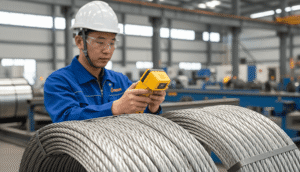
For large‑scale industrial projects, you should always demand a Material Test Report (MTR) or Mill Test Certificate (MTC) from your supplier. This document gives the chemical analysis[^10] of the steel from the original mill and confirms the grade against international standards. It is the most reliable way to verify that the material you receive matches what was specified.
At iRopeWork, every batch of 316 stainless steel[^4] wire rope[^1] and rigging hardware can be supplied with MTR / MTC on request. This allows your engineering and quality teams to cross‑check the grade and key elements, instead of relying purely on labels or trust in the supply chain.
Conclusion
In short, choose 304 stainless steel[^2] wire rope[^1] for dry, indoor applications[^11] where the environment is controlled and non‑corrosive – it will save cost without sacrificing performance. For outdoor, coastal, marine or chemically aggressive environments, always specify 316 stainless steel[^4] to secure long‑term corrosion resistance[^3] and safety.
Before you place an order or approve a drawing, ask yourself three questions: Where will this rope be installed? What corrosive agents might it see over 5–10 years? And is the small saving on 304 worth the risk of earlier replacement or failure? If any of these answers point to higher risk, 316 is usually the safer engineering choice.
[^1]: Get insights on selecting the right wire rope for your projects to enhance safety and performance. [^2]: Explore the properties of 304 stainless steel to understand its applications and limitations in various environments. [^3]: Understanding corrosion resistance can help you choose the right materials for your projects, ensuring longevity and safety. [^4]: Learn why 316 stainless steel is often preferred for marine and corrosive environments, enhancing your material selection knowledge. [^5]: Find out what makes marine grade stainless steel unique and why it's essential for coastal applications. [^6]: Understand the relationship between material selection and project safety to make informed decisions. [^7]: Discover how molybdenum enhances the performance of stainless steel, particularly in harsh environments. [^8]: Learn about pitting corrosion to better protect your projects from potential failures due to material degradation. [^9]: Explore the impact of de-icing salts on stainless steel to make better material choices for winter conditions. [^10]: Explore the process of chemical analysis to ensure the integrity and specifications of your materials. [^11]: Understand the ideal scenarios for using 304 stainless steel to maximize performance and cost-effectiveness.