Are you struggling to choose the right stainless steel grade for your project? The wrong decision wastes budget[^1], shortens service life and can even create safety risks[^2]. This guide walks you through the real differences so you can specify materials with confidence in drawings and RFQs.
The main difference is the alloying element molybdenum[^3]. AISI 316 stainless steel[^4] contains molybdenum[^3], which gives it much better resistance to chloride‑induced corrosion[^5] from salt and many harsh chemicals. That is why 316 is the standard choice for marine and industrial environments, while AISI 304[^6] is usually the better option for general, less corrosive conditions.

I have been in the metal products industry for 17 years. In that time, I’ve seen many smart engineers make costly mistakes with material selection. They understand the basics, but they don't always consider the long-term reality. The choice between 304 and 316 stainless steel seems simple on the surface. But this decision impacts your budget[^1], your project's lifespan, and its safety. Let's go beyond the spec sheets. I will share what I've learned from the factory floor to help you make a decision you won't regret.
Beyond the price tag: a cost–benefit view for B2B purchasers
You see the unit price difference and it is tempting to save money with 304. But what if that initial saving leads to major replacement costs[^7] and project downtime a few years later?
While 316 rigging hardware has a higher upfront cost, it usually delivers a better total cost of ownership[^8] in corrosive environments. It reduces the frequency of maintenance, avoids early replacement labour and lowers the risk of unexpected failures, making it the more economical choice over the full life of the project.

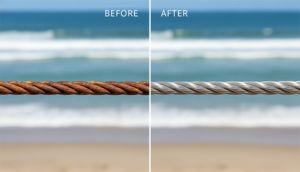
In procurement, the initial price is always a major factor. I understand that. But as an engineer, you know the total cost of ownership[^8] is what really matters. I once worked with a client on a coastal building project[^9]. They chose 304 stainless steel railings to save about 20% on the hardware budget[^10]t](https://www.iso.org/obp/ui/en/#!iso:std:79083:en)[^1]. For the first year, everything looked fine. But by the third year, small rust spots, or tea staining[^11], appeared on nearly every connection point. The salt in the air was slowly eating away at the material. They ended up spending more than double their initial savings on labor and materials just to replace it all with 316. This is a common story. The real cost isn't just the price on the invoice. You must think about the future.
True Cost Comparison
| Cost Factor | AISI 304[^6] (in Coastal Area) | AISI 316 (in Coastal Area) |
|---|---|---|
| Initial Purchase | $8,000 | $10,000 |
| Lifespan | 2-4 Years | 20+ Years |
| Replacement Cost | $8,000 (Hardware) + $5,000 (Labor) | $0 |
| Total 5-Year Cost | $21,000 | $10,000 |
This simple table shows the reality behind the numbers: a small saving on initial hardware can turn into much higher total cost within just a few years.
When you evaluate offers, try to estimate not only the purchase price, but also expected service life, probability of replacement and the cost of labour and downtime. If these factors are significant, 316 often becomes the more economical and safer engineering choice[^12], even with a higher line‑item price.
When 304 is “good enough” and when 316 is a must
You need to specify materials, but you don't want to over-engineer and waste budget[^1]. How do you know for sure when 304 is fine and when you absolutely need to use 316?
Use 304 stainless steel for indoor applications or dry, non‑polluted outdoor areas where the atmosphere is stable and free from chlorides. It performs very well for architectural details away from the coast. Use 316 whenever the project is near the ocean, in industrial zones with airborne pollutants, or in regions where de‑icing salts[^13] are used in winter – in these environments, 304 is much more likely to suffer from pitting and tea staining[^11].

Making the right call is about understanding the specific environment, not just the material. I tell my clients to think about what the hardware will be exposed to every single day. Is there salt in the air? Are there industrial chemicals nearby? Will it be exposed to road salt in the winter? These questions are more important than the material's name. A beautiful indoor staircase can use 304 hardware and it will look great for decades. It is protected and the environment is stable. But take that same hardware and install it on a dock in a marina. The constant exposure to saltwater will cause pitting corrosion[^14], which is a dangerous type of localized rust that can lead to sudden failure. It's not about which grade is "better." It's about which grade is right for the job.
Application Guide
Your project's location is the most important factor in this decision.
Use AISI 304[^6] When:
- The environment is indoors and climate‑controlled.
- The project is outdoors but far from the coast and heavy industrial pollution[^15].
- The application is mainly decorative, in a mild and low‑chloride climate.
- Examples: Indoor glass railings, kitchen equipment, architectural trim in a dry inland city.
Use AISI 316 When:
- The project is within roughly 50 kilometres of the ocean or exposed to sea spray.
- The hardware will be frequently wet or submerged in water (fresh or salt).
- The environment has noticeable industrial pollution[^15] or chemical exposure.
- De‑icing salts are used on nearby roads, walkways or structures during winter.
- Examples: Balustrades on coastal buildings, boat rigging, swimming pool ladders, bridge hardware and roadside safety systems.
Choosing correctly is the first step to ensuring both safety and longevity.
A manufacturer’s perspective on material selection and longevity
You've heard other suppliers say "our 316 will never rust." You know this is too simple. How do you find a supplier who tells you the truth and provides a product that actually lasts?
Even 316 stainless steel can rust if it's poorly manufactured or installed. True longevity comes from combining the right material with strict quality control[^16]. So, you need a supplier who provides certified materials and understands processes like passivation[^17] to prevent surface contamination.

Many suppliers just sell a product. They don't understand the science behind it. I've built my career on understanding the materials I work with. Here is an important truth: stainless steel's corrosion resistance comes from a thin, invisible layer of chromium oxide on its surface. If this layer is damaged or contaminated, rust can form, even on 316. This happens for a few reasons. Sometimes, tiny iron particles from cutting tools get embedded in the surface during manufacturing. In a salty environment, these particles rust and stain the stainless steel. This is why a good manufacturer will perform a process called passivation[^17], which is a chemical cleaning that removes these contaminants and helps restore the protective layer. A responsible manufacturer will be transparent about this. We provide genuine Material Test Certificates (MTCs)[^18] that show the exact chemical composition of the steel, including the crucial molybdenum[^3] content in 316, for every batch. This allows your engineers and quality team to verify that the material truly matches the specification.
In other words, do not rely only on marketing promises or surface appearance. Always ask for data and documentation that can be checked and traced.
Why Quality Control Matters More Than Marketing
| Common Problem | Poor Manufacturer's Approach | iRopeWork's Quality Approach |
|---|---|---|
| Surface Contamination | Skips cleaning to save money | Multi-stage cleaning and passivation[^17] |
| Material Sourcing | Uses cheap, unverified steel | Sources from certified mills |
| Verification | Provides fake or generic certificates | Provides a genuine MTC for every batch |
| Expertise | Salesperson repeats marketing claims | Engineers explain the real science |
In the end, the name "316" is just a label. The performance of the hardware depends on the integrity of the manufacturer behind it.
Conclusion
Choosing between 304 and 316 stainless steel is ultimately about matching the material to the real environment and expected service life of your project. When this is done correctly, you protect both safety and budget[^1] over the long term.
Before you finalise a specification or place an order, ask yourself three questions: What will this hardware be exposed to every day over the next 5–10 years? What would be the real cost if it had to be replaced early? And can my supplier prove, with certificates and clear processes, that their 316 is truly what they claim? If you can answer these questions with confidence, you are already ahead of most buyers in this market.
[^1]: Learn effective budget management strategies to ensure project success and avoid overspending. [^2]: Understand the safety implications of material choices and how to mitigate risks in projects. [^3]: Learn how molybdenum enhances the properties of stainless steel, making it ideal for harsh environments. [^4]: Explore the advantages of AISI 316, especially its corrosion resistance, crucial for marine and industrial applications. [^5]: Understand the risks of chloride-induced corrosion and how to mitigate them in your projects. [^6]: Discover the properties of AISI 304 and when it is suitable for use in various applications. [^7]: Explore methods to accurately estimate replacement costs and avoid budget overruns. [^8]: Gain insights into the total cost of ownership concept and its importance in material selection. [^9]: Discover the unique challenges and material requirements for building in coastal environments. [^10]: Explore strategies for optimizing hardware budgets while ensuring quality and safety. [^11]: Find out what tea staining is and how it affects the appearance and integrity of stainless steel. [^12]: Discover the key factors that engineers consider when selecting materials for projects. [^13]: Learn how de-icing salts can compromise stainless steel and how to choose materials accordingly. [^14]: Learn about pitting corrosion, its causes, and how to prevent it in your projects. [^15]: Understand the impact of industrial pollution on material choices and project longevity. [^16]: Explore the importance of quality control in ensuring the longevity and performance of materials. [^17]: Understand the passivation process and its significance in enhancing stainless steel durability. [^18]: Learn about MTCs and how they ensure the quality and compliance of stainless steel materials.