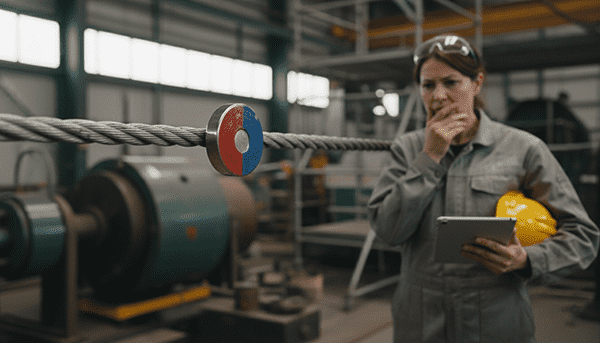
You’ve received your shipment of 316 stainless steel wire rope[^1], but a quick check with a magnet gives you a nasty surprise—it sticks. Your first thought is that you've been scammed with a cheaper, inferior material. How can you be sure?
High-quality 316 stainless steel wire rope[^1] can become slightly magnetic. This happens because the manufacturing process, known as cold working[^2], changes the steel's internal structure. This slight magnetism[^3] is a normal physical phenomenon and does not mean the material is fake or of poor quality.
This discovery can be frustrating. You paid for premium, non-magnetic stainless steel for its corrosion resistance[^4] and durability, and now you're questioning the entire batch. As someone who has been in the metal products industry for 17 years, I've seen this exact situation puzzle even experienced engineers like Mr. Xu. The good news is that there’s a clear, scientific explanation for this, and it doesn't always mean you should be worried. Understanding the "why" is the first step toward verifying quality with confidence.
Debunking the Myth: Why Can High-Quality 316 Still Be Slightly Magnetic?
You specify Grade 316[^5] for its superior corrosion resistance[^4], expecting it to be non-magnetic. So when a magnet shows a slight pull, it feels like a betrayal of quality. This moment of doubt can cause major project delays and trust issues with your supplier.
The process of drawing steel into a wire, known as "cold working[^2]," alters its microscopic structure. This deformation can cause some of the non-magnetic austenite[^6] to transform into slightly magnetic martensite[^7]. This is a normal and expected outcome in high-strength wire rope, not a sign of impurity.
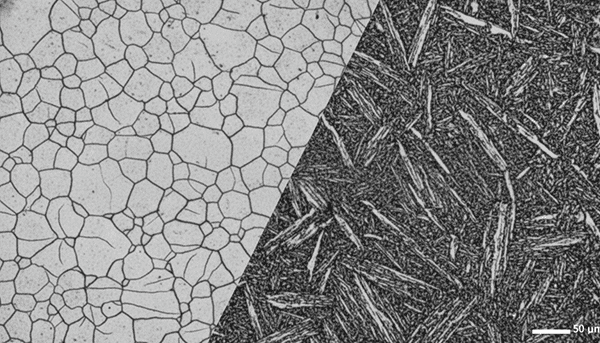
Let me dive a bit deeper into the science. Stainless steel grades like 304 and 316 start with a crystal structure called austenite[^6], which is non-magnetic. However, when we manufacture wire rope, we pull and shape the steel at room temperature. This intense mechanical stress[^8] is what we call "cold working[^2]." This process is what gives the wire its high tensile strength[^9], but it also forces a portion of the austenite[^6] crystals to rearrange themselves into a new structure called martensite[^7]. Martensite is magnetic.
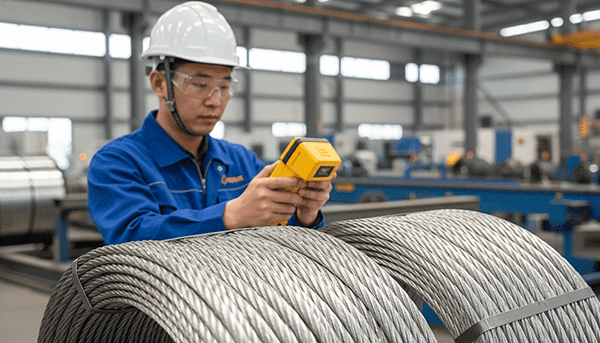
I remember a client, a senior engineer much like Mr. Xu, who called me in a panic. He was ready to reject a huge shipment because his magnet testing showed a slight pull. He was convinced we had shipped him a lower grade. I flew out to his facility with our handheld XRF analyzer[^10]. We spent the next hour testing ropes from the batch. The analyzer confirmed the chemical composition was perfect—the nickel, chromium, and molybdenum content were all squarely within 316 specs. The magnetism[^3] he was seeing was a direct result of the high-strength drawing process he had specified. It was evidence of the work hardening that made the rope strong, not a sign of a cheap material.
Here's a simple breakdown:
| Microstructure | Magnetic Property | Key Characteristic |
|---|---|---|
| Austenite | Non-Magnetic | The original state of 316 stainless steel, highly corrosion-resistant. |
| Martensite | Magnetic | Formed under stress (cold working[^2]), increases strength and hardness. |
This transformation is more pronounced in some grades than others, but it's a fundamental part of steel metallurgy. So, a slight magnetic response is often a byproduct of a strong, well-made wire rope.
So, How Can You Tell Good Steel from a Bad Fake?
The real fear is that this magnetism[^3] isn't from cold working[^2], but from a supplier substituting cheaper, rust-prone material[^11] like Grade 304[^12] or even chrome-plated carbon steel. This deception could lead to catastrophic failures and severe damage to your company's reputation.
A magnet test is not a reliable way to confirm stainless steel grades. The only definitive way to verify the material is through a chemical composition analysis[^13]. A Material Test Certificate (MTC)[^14] or a spectrometer test will prove the correct percentages of chromium, nickel, and molybdenum are present.
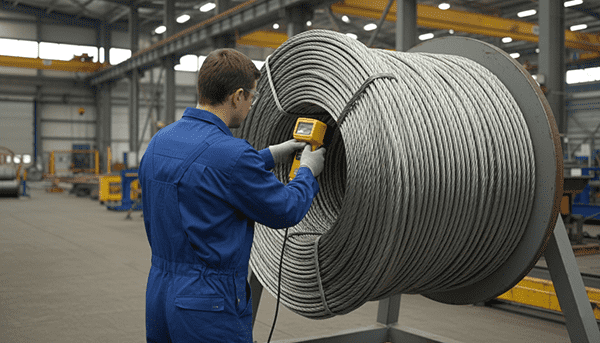
While a simple magnet test can be misleading, it’s not completely useless. You just need to know what you’re looking for. The slight magnetism[^3] from cold-worked 316 is typically weak and can be inconsistent along the wire. In contrast, a lower-grade material like a 400-series stainless or carbon steel will be strongly and uniformly magnetic right away. But relying on this "feel" is risky and not something a professional should bet their project on.
Visual inspections can also be deceiving. A polished, lower-grade steel can look identical to a high-quality 316 steel at first glance. I’ve seen counterfeit products[^15] with flawless finishes that start showing signs of rust within weeks of being exposed to the elements. This is why verifiable documentation is non-negotiable for any critical application.
The gold standard for verification is a Material Test Certificate (MTC)[^14], sometimes called a Mill Test Report (MTR). This document is like a birth certificate for the steel, tracing it back to the original heat from the mill. It shows the precise chemical breakdown of that specific batch. At iRopeWork, we provide an MTC with every shipment. It’s our guarantee that what you ordered is what you received. The key elements to check for Grade 316[^5] are:
- Chromium (Cr): Typically 16-18%
- Nickel (Ni): Typically 10-14%
- Molybdenum (Mo): Typically 2-3% (This is the key element that gives 316 its superior corrosion resistance[^4] and is absent in 304).
For Mr. Xu, and for anyone whose reputation rests on the quality of their components, guessing is not an option. The only way to operate is with data you can trust.
When Should Magnetism Actually Be a Red Flag?
You now understand that slight magnetism[^3] is normal. But at what point should that magnetic pull switch from being a curiosity to a serious cause for concern? Ignoring a real warning sign could have severe consequences for project safety and longevity.
Strong, uniform magnetism[^3] across the entire wire rope should be treated as a major red flag. If you ordered Grade 316[^5], this almost certainly indicates that a lower-cost, less corrosion-resistant magnetic grade of steel was supplied instead, which will fail prematurely in its intended environment.
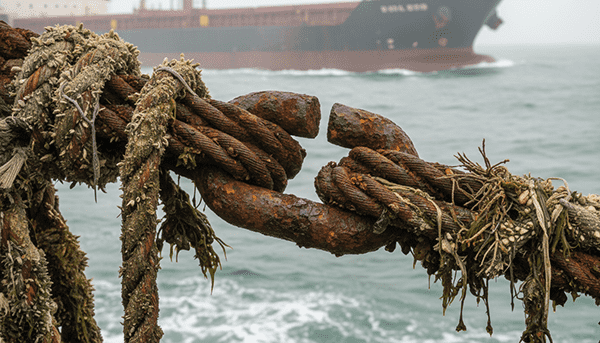
If you take a strong magnet and it clamps firmly onto the wire rope, refusing to let go, you have a problem. This is not the subtle pull of cold-worked austenite[^6]; it is the definitive attraction of a ferritic or martensitic steel. While these steels have their uses, they do not have the corrosion resistance[^4] of Grade 316[^5], especially in marine or industrial environments.
Using the wrong material in a critical application is a recipe for disaster. A project designed with the chloride-pitting resistance[^16] of 316 in mind will fail if a lesser material is used. I've seen firsthand how quickly a lower-grade stainless steel can rust and degrade, especially in saltwater environments. The failure isn't just a matter of aesthetics; it's a critical safety issue that can lead to property damage, injury, or worse. The cost savings from using a counterfeit material are never worth the risk.
Here’s a clear comparison of why grade matters:
| Feature | Grade 304[^12] Stainless Steel | Grade 316[^5] Stainless Steel |
|---|---|---|
| Magnetism | Becomes slightly magnetic after cold work. | Becomes slightly magnetic after cold work. |
| Corrosion Resistance | Good for general atmospheric conditions. | Excellent, especially against chlorides (saltwater, de-icing salts). |
| Key Alloying Element | Chromium, Nickel. | Chromium, Nickel, Molybdenum. |
| Typical Application | Kitchen equipment, architectural trim. | Marine rigging, chemical processing[^17], coastal structures. |
Ultimately, our mission at iRopeWork is to eliminate this uncertainty. By providing easy-to-understand knowledge and backing it up with verifiable quality control documents, we help ensure every project is built with the right material for the job. Verifying the material grade isn't just good practice; it's fundamental to building safe, durable, and reliable projects.
Conclusion
Slight magnetism[^3] in 316 wire rope is a normal result of manufacturing, not a sign of a fake. However, the only way to be certain is to demand a chemical analysis report.
Concerned about getting counterfeit materials? Check out a sample of our Material Test Certificates to see how we guarantee quality with every order.
[^1]: Explore the applications of 316 stainless steel wire rope to understand its importance in various industries. [^2]: Learn about cold working and its effects on metal properties, crucial for understanding material behavior. [^3]: Discover the science behind magnetism in stainless steel and its implications for material quality. [^4]: Understand the mechanisms of corrosion resistance in stainless steel to ensure material longevity. [^5]: Learn why Grade 316 is preferred for demanding environments and its unique properties. [^6]: Learn about austenite's role in stainless steel and its properties. [^7]: Discover the formation of martensite and its impact on steel strength. [^8]: Understand mechanical stress and its effects on material properties and performance. [^9]: Learn about high tensile strength and its significance in engineering applications. [^10]: Understand how XRF analyzers work and their importance in material testing. [^11]: Identify materials that are susceptible to rust and their implications for safety. [^12]: Explore the characteristics of Grade 304 stainless steel and its applications. [^13]: Explore the methods of chemical composition analysis to ensure material integrity. [^14]: Find out the significance of MTCs in verifying material quality and compliance. [^15]: Explore ways to detect counterfeit materials to ensure project safety. [^16]: Discover the importance of chloride-pitting resistance for materials used in harsh environments. [^17]: Learn about the material challenges in chemical processing and how to address them.