Mixing up steel grades destroys projects. You risk rapid corrosion and costly replacements if you select the wrong wire rope for your environment. You need technical clarity to decide.
The choice depends on the specific environment. AISI 304[^1] is cost-effective for indoor or dry areas. AISI 316[^2] contains Molybdenum[^3], making it essential for marine, coastal, and chemical environments due to its superior resistance to chloride corrosion[^4]. Always match the grade to the exposure level.
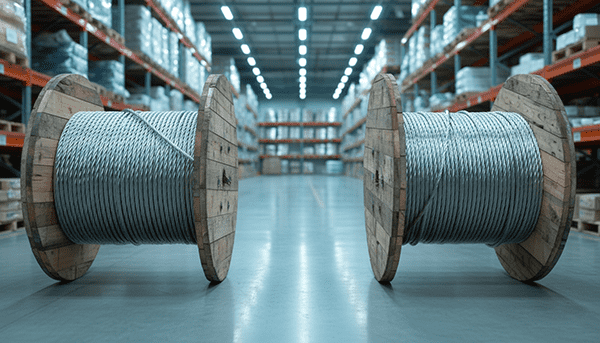
I have spent 30 years in metal manufacturing. I see the same mistake happen constantly. A project manager tries to save money by buying the cheaper option, and six months later, the cable snaps. Let’s look at the science so you can make the right choice.
LOOP START
What Is the Chemical Difference That Makes 316 Superior to 304?
You cannot see the difference with your naked eye. But at a molecular level, one element changes everything about how long your cable lasts in a harsh environment.
The critical difference is Molybdenum[^3]. AISI 304[^1] works fine generally, but AISI 316[^2] adds 2-3% Molybdenum[^3]. This specific addition creates a barrier against pitting corrosion[^5] caused by chlorides found in salt water and industrial pollution.
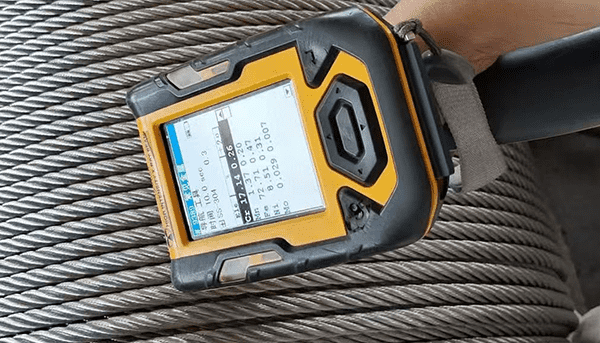
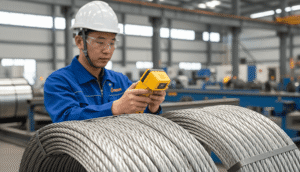
As a manufacturer, I test raw materials every day. When I look at a coil of wire rope, I cannot tell if it is 304 or 316 just by looking at it. They both shine the same way when they are new. The difference is inside.
We use a machine called a spectrometer to read the chemical "DNA" of the steel. The standard "18/8" stainless steel is what we call AISI 304[^1]. It has 18% Chromium and 8% Nickel. This is great for making spoons or indoor railings.
However, AISI 316[^2] is what we call "Marine Grade." It has slightly more Nickel, but the magic ingredient is Molybdenum[^3] (Mo). This element is expensive, which is why 316 costs more. But you cannot skip it if you are near the ocean.
Here is the breakdown from my lab data:
| Element | AISI 304[^1] (Standard) | AISI 316[^2] (Marine) | Function |
|---|---|---|---|
| Chromium | 18% - 20% | 16% - 18% | Forms the passive layer to stop rust. |
| Nickel | 8% - 10.5% | 10% - 14% | Instability and strength. |
| Molybdenum[^3] | 0% (None) | 2.0% - 3.0% | Resists salt (chlorides) and acid. |
I often see suppliers try to cheat here. They might sell you "316" that only has 0.5% Molybdenum[^3]. That is not 316. It will rust just like 304. We strictly reject anything under 2.0% Mo in my factory. If you do not have Molybdenum[^3], the salt water bites into the metal and creates deep "pits" or holes. These pits create stress points, and the wire will eventually break under a load that it should have handled easily.
LOOP END
LOOP START
Which Environment Requires 316 Wire Rope to Avoid Safety Failure?
Guessing the environment leads to overspending or catastrophic failure. You need a verified framework to decide without hesitation and protect your liability.
Use a simple rule: If salt or chemicals are present, use 316. For interior architecture or dry inland manufacturing, 304 is sufficient. Detailed assessment of humidity, salinity, and chemical exposure[^6] prevents future liability.
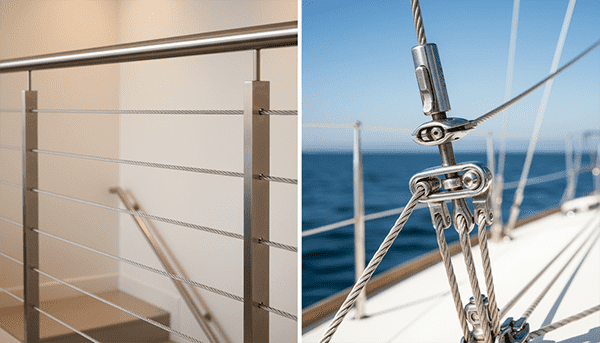
I talk to procurement officers[^7] who want to use 304 for everything to simplify their inventory. This is a bad strategy. On the other hand, some engineers specify 316 for an office ceiling suspension. That is a waste of budget.
You need to look at the location of your project. Corrosion depends on presence of moisture and chlorides (salt).
I have created this decision matrix based on the projects I have supplied over the last 17 years:
| Environment | Recommended Grade | Why? |
|---|---|---|
| Indoor (Dry) | AISI 304[^1] | No moisture or salt. 304 will stay shiny for decades. |
| Indoor (Pool) | AISI 316[^2] | Chlorine fumes from the pool water will eat 304 rapidly. |
| Outdoor (Inland) | AISI 304[^1] | Rainwater is usually fine for 304. Clean it once a year. |
| Coastal (< 5 miles) | AISI 316[^2] | Salt mist is in the air. 304 will develop "tea staining" (brown spots) within weeks. |
| Marine (Submerged) | AISI 316[^2] | Direct contact with saltwater. Check connections frequently. |
| Industrial | AISI 316[^2] | Factories often have sulfur or chemicals in the air. |
I once supplied rigging for a hotel balcony project. The hotel was 2 miles from the beach. The buyer insisted on 304 to save 20%. Six months later, the beautiful stainless cables were covered in brown rust spots. The hotel had to replace all of them. The labor cost to replace them was ten times higher than the money they "saved" on the material.
If you are unsure, choose 316. It is the safer bet for any outdoor application.
LOOP END
LOOP START
How Does Construction Affect the Application of Your Wire Rope?
Choosing the right grade is only half the battle. If you pick the wrong strand construction, the cable will not perform the physical task required.
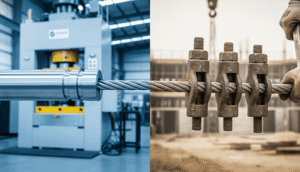
Select 1x19 construction[^8] for static applications like standing rigging or architectural balustrades because it offers high stiffness and low stretch. Choose 7x19 for running rigging, winches, or pulleys where flexibility and fatigue resistance are required.
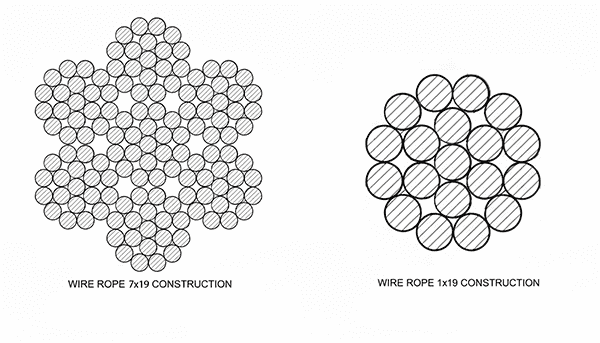
Many people focus so much on the "304 vs 316" debate that they forget about the structure of the rope itself. You can buy both 304 and 316 in different constructions. The construction dictates how the rope moves.
In my factory, we manufacture two main types for these markets:
- 1x19 Construction: This is 19 wires twisted into one single strand.
- 7x19 Construction: This is 7 strands, and each strand has 19 wires.
Think of 1x19 as a solid rod that bends a little bit. It is very stiff. It is beautiful and smooth. We use this for:
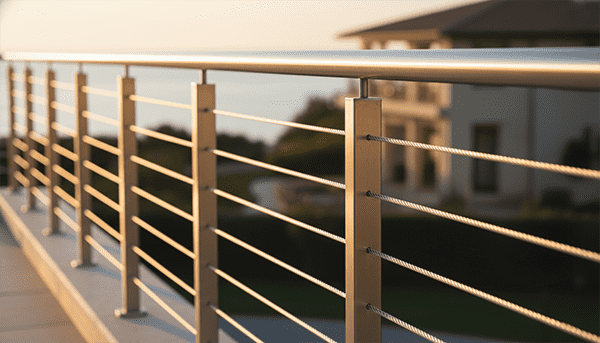
- Architectural railings (it looks better and doesn't trap dirt).
- Mast stays on boats (standing rigging).
- Push-pull control cables.
- Do not use this with pulleys. It is too stiff and will break if you bend it repeatedly.
Think of 7x19 as a true rope. It creates a flexible cable. We use this for:
- Winch lines.
- Running rigging (halyards) on boats.
- Exercise equipment cables.
- Anywhere the cable passes over a sheave.
| Spec | 1x19 Wire Rope | 7x19 Wire Rope |
|---|---|---|
| flexibility | Low (Rigid) | High (Flexible) |
| Stretch | Low (Holds tension) | High (Elastic) |
| Strength | Higher Breaking Load | Slightly Lower |
| Primary Use | Static (Holding things in place) | Dynamic (Moving things) |
When you order, give me both specs. For example: "I need AISI 316[^2], 7x19 construction." If you just say "Stainless Cable," a trader will give you whatever they have in stock, which is dangerous.
LOOP END
LOOP START
Is the Higher Price of 316 Stainless Steel Worth the Investment?
High upfront costs often scare procurement officers[^7]. However, looking at the sticker price alone is a beginner's mistake in asset management and long-term planning.
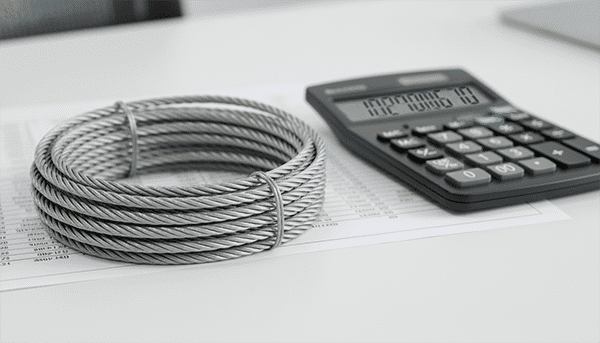
While AISI 316[^2] costs 30-40% more upfront than 304, it eliminates replacement costs in harsh environments. For B2B projects, the Total Cost of Ownership[^9] (TCO) is lower with 316 because it lasts years longer without maintenance or failure.
Price is always the first question I get. "Mr. Xu, why is this cable more expensive than the other one?"
The market price of Nickel and Molybdenum[^3] changes daily. Generally, AISI 316[^2] is about 30% to 40% more expensive than AISI 304[^1]. If a project requires $10,000 of 304 cable, the 316 option might cost $13,500.
For a procurement officer, that $3,500 saving looks good on a spreadsheet today. But let's look at the Total Cost of Ownership[^9] (TCO).
In the metal industry, the material is actually the cheapest part of a project. The expensive part is Labor and Access.
- Installation Cost: You have to pay workers to swage the fittings and tension the lines.
- Access Cost: Do you need scaffolding? Do you need a crane?
- Downtime Cost: If a machine stops because a cable snapped, how much money do you lose?
If you use 304 in a coastal area, it will rust in 1 to 2 years. You will have to pay for removal, buy new material, and pay for installation again.
The Calculation:
- Option A (304): Material ($10k) + Install ($10k) = $20,000. Life: 2 years.
- Option B (316): Material ($13.5k) + Install ($10k) = $23,500. Life: 20 years.
Over 20 years, Option A costs you $200,000. Option B costs you $23,500.
I supply many government projects. They always calculate the TCO. If you are a distributor selling to a contractor, teach them this math. They will trust you more, and you will sell the higher-value product. It is a win-win.
LOOP END
Conclusion
Choose AISI 316[^2] for salt exposure, AISI 304[^1] for dry areas; match the 1x19 or 7x19 construction to the movement needs, and prioritize long-term value over short-term savings.
[^1]: Explore the advantages of AISI 304 for indoor applications and its cost-effectiveness. [^2]: Learn why AISI 316 is essential for marine environments and its superior corrosion resistance. [^3]: Discover how Molybdenum enhances the durability of stainless steel in harsh conditions. [^4]: Understand the impact of chloride corrosion and how to prevent it in your projects. [^5]: Find out how to protect your metal structures from pitting corrosion. [^6]: Learn about the effects of chemicals on stainless steel and how to mitigate risks. [^7]: Learn key considerations for procurement officers when selecting stainless steel. [^8]: Explore the applications of 1x19 construction in static environments. [^9]: Learn about TCO and how it influences long-term investment decisions.